
Data Security
GDPR compliance built into the platform, not bolted on afterward.
Access control
Every user sees exactly what they're permitted to see — nothing more. Permissions are defined at the role and functionality level: who can create, edit, publish, or delete, and within which modules. N3 uses a policy-based permission system that maps cleanly to how organizations actually work — by role and responsibility, not by individual field configuration.
Form data management
Forms are where personal data enters your system, which makes them the most compliance-critical part of any content platform. N3 treats form data accordingly.
Automatic data expiry
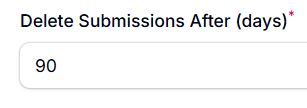
Every form can be configured to purge its collected data automatically after a defined number of days — calculated from the form's expiry date. Once a form is no longer active, the clock starts. No manual cleanup, no forgotten datasets sitting in a database years after an event.
Sensitive field handling
Each form field can be individually marked as containing sensitive data. Marked fields are masked in the interface — visible only to authorized data owners, hidden from everyone else. Email addresses are masked by default, without any additional configuration required.
Data ownership
Forms can be assigned dedicated data owners — the only users who can export submissions or import pre-existing lists. Exports are password-protected, non-editable Excel files: the data owner sets the password at the time of download, and only they can open the file.
Follower notifications
Users can follow a form to receive notifications about new submissions or aggregate counts — without ever seeing the underlying data. Followers know that responses are coming in. The data itself remains invisible to them.
Access control is policy-based, covering every model and operation — create, read, update, delete — enforced at the framework level. The admin interface automatically respects these policies: users only see what they are authorized to access. Roles and permissions are built on Spatie Permission with 24-hour caching; changes take effect without a deployment.
Each form can be configured with an expiry date. Once the form is no longer active, the system automatically begins counting down to the deletion date and purges collected data after the defined number of days. No manual cleanup, no forgotten datasets persisting years after an event.
Any individual form field can be marked as containing sensitive data, regardless of field type. Marked fields are masked in the interface and visible only to authorized data owners. Email address fields are masked by default without any additional configuration.
Any authorized user can be designated as a data owner for a specific form. Data owners are the only users permitted to export submissions or import pre-existing lists. Assignment is done per form in the admin interface.
When a data owner exports form submissions, they set a password at the time of download. The exported file is a non-editable Excel file, encrypted with that password. Only the person who set the password can open it — no one else in the system has access to the export after it leaves.
Yes. Every model change is automatically tracked — who made it, when, from which IP address, and what exactly changed, field by field, with old and new values. Login and logout events are recorded with IP and user agent. Audit logs are automatically pruned after 365 days (configurable).
All data is stored in European data centers. No transfers to third-party servers abroad. No plugins phoning home, no external scripts with hidden data collection.